
 en
en English
 Español
 Français
 русский
 عربى
عربى
Bagel Making Machine Guide: How They Work, Types, and What to Check Before Buying
Content
A bakery that shapes 500 bagels by hand before sunrise pays three skilled workers, accepts a weight spread of five to ten grams between pieces, and still risks a lopsided hole whenever the dough proofs longer than planned. Those three pressures - labor cost, tolerance drift, and fatigue - are usually what push an operation to evaluate a bagel making machine. The short conclusion: a bagel forming machine is worth buying once daily volume passes roughly 1,000 pieces, weight consistency has turned into a customer complaint, and you have mixing, proofing, boiling, and baking capacity that can keep pace. The machine itself automates only dividing, rounding, and ring forming, so the stages around it decide whether the investment pays back.
What a Bagel Making Machine Actually Does
Despite the name, a bagel making machine is not one device that turns flour into a finished bagel. It is a forming machine: it takes prepared dough portions, rolls and presses them, and shapes them into rings with a consistent center hole. Three functions cover almost every design on the market:
- Dividing: cutting bulk dough into equal-weight pieces, typically 90 to 120 grams for a standard raw bagel.
- Rounding: tightening each piece into a smooth ball so surface tension develops before shaping.
- Ring forming: opening the hole by pressing the ball over a center punch, extruding a ring and cutting it to length, or rolling a dough cylinder around a mandrel.
Mixing, bulk fermentation, final proofing, boiling, and baking remain separate steps handled by other equipment. Many tabletop formers skip the dividing stage entirely and expect rounded dough balls to be fed in, either by hand or from an upstream divider-rounder. Fully inline systems combine dividing, rounding, resting, and ring forming under one conveyor flow.
A Short History That Still Shapes Buying Decisions
Bagels were shaped by hand in North American bakeries for most of the twentieth century, and production in New York was tightly controlled by a craft union for decades. In the early 1960s, inventor Daniel Thompson developed the first commercially practical bagel machine, which rolled, pressed, and shaped dough into uniform rings. Lender's Bagels adopted the technology and paired it with freezing, and that combination moved bagels from Jewish delis onto supermarket shelves, then into the mainstream bakery category they occupy today.
The historical trade-off still matters to buyers. Early machines produced a cleaner, more uniform bagel than hand shaping, and some artisan bakers still charge a premium for the slightly irregular hand-rolled look. When you evaluate machines now, ask how much of that character the former lets you keep or deliberately remove: die geometry, punching pressure, and rounding settings all influence whether output looks uniform or rustic.
Main Types of Bagel Making Machines
Tabletop and batch formers
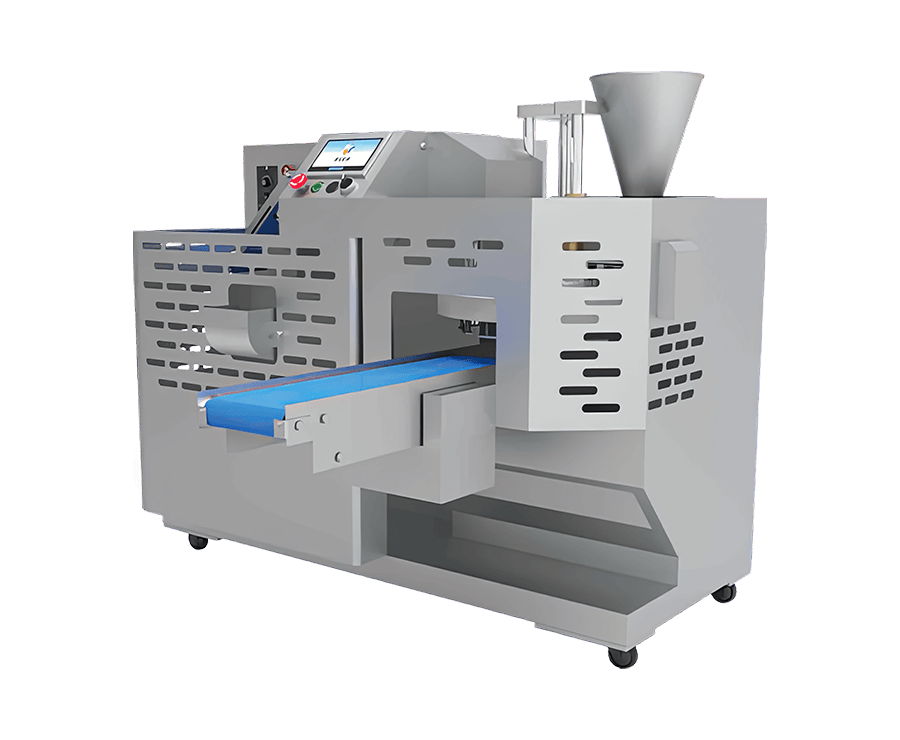
These compact units accept rounded dough balls and form one ring at a time, usually at 1,000 to 2,500 pieces per hour with a single operator. They suit retail bakeries, cafes, hotel kitchens, and central kitchens producing bagels alongside other items. The footprint is small, cleaning is manageable, and an operator can inspect each piece. The trade-off is that feeding still depends on people, so output caps out quickly and quality follows the feed rate.
Inline automated forming systems
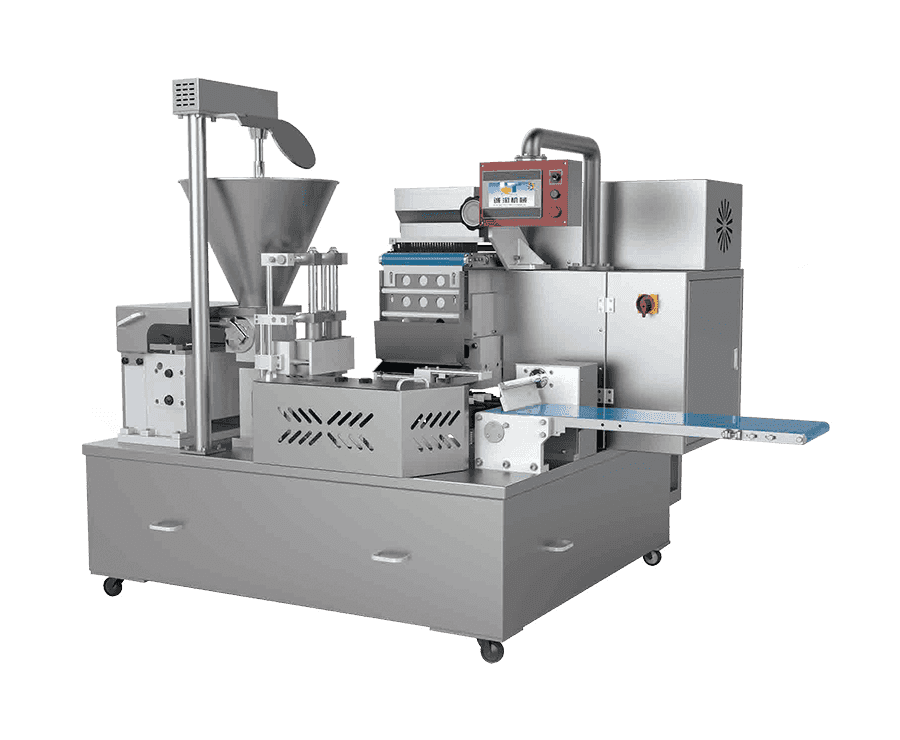
Inline lines integrate dividing, rounding, resting, ring forming, and tray arrangement, running from roughly 3,000 to well over 10,000 pieces per hour. This is the category used by frozen bagel producers and industrial bakeries. Expect a larger footprint, longer changeovers between products, and a stronger dependence on dough consistency upstream, because an inline system repeats whatever the mixer and divider deliver, for better and for worse.
Where Forming Fits in the Full Production Line
The forming machine sits in the middle of the line, and the stages around it are where most bagel projects either succeed or stall.
Mixing. Bagel dough is stiff, usually mixed to roughly 55 to 62 percent hydration, compared with 65 to 75 percent for typical bread dough. That stiffness is what lets a bagel hold its ring shape through the kettle, but it also loads the mixer and generates heat, and dough that warms past around 24 °C starts proofing early and deforms during forming. The first thing to verify is a commercial dough mixer sized for stiff doughs rather than general bread work; this walkthrough of how a mixer handles different dough types covers the questions to ask.
Dividing and rounding. Whatever the former receives, it repeats. A divider that varies by four grams produces rings that vary visibly after baking. Dedicated rounding and aligning equipment upstream gives the former a consistent ball, which is why stable bagel lines treat rounding as its own step rather than an afterthought.
Proofing. Many operations retard shaped bagels overnight at about 4 °C, then proof them for one to two hours before boiling. A controlled fermentation cabinet keeps temperature and humidity inside a narrow band, which matters because under-proofed dough shrinks in the kettle while over-proofed dough collapses around the hole.
Kettling and baking. Boiling, typically 30 to 90 seconds per side in water with barley malt syrup or, for some styles, a brief lye dip, gelatinizes the surface and sets the crust before baking. If the former outputs 3,000 pieces per hour but the kettle handles 1,500, the real line rate is 1,500, and dough waiting in queue over-proofs. Size the slowest stage first, then choose the former.
Specs and Tolerances Worth Checking
Brochures lead with pieces per hour, but these figures decide day-to-day performance:
- Weight accuracy: plus or minus 1 to 2 grams on a 100-gram piece is a reasonable target; beyond plus or minus 4 grams, bake color and cook time start to drift visibly.
- Diameter and hole size: outer diameter holding within about 2 to 3 millimeters, and a hole that stays centered as line speed changes.
- Dough tolerance: how wide a hydration range, and how much recipe variation, the machine accepts without manual adjustment.
- Changeover time: under 20 to 30 minutes between bagel sizes or products keeps a multi-product plant genuinely flexible.
Hygiene deserves equal attention. Stiff bagel dough is drier than bread dough, so it crumbles and dries hard in crevices; look for smooth stainless food-contact surfaces, quick-release dies, and tool-free disassembly of the rounding chamber. Before comparing models, anchor the discussion with realistic output and labor expectations:
| Approach | Typical output | Forming staff | Weight consistency | Best fit |
|---|---|---|---|---|
| Hand shaping | 150-300 pieces per hour | 1 skilled worker per 300 pieces | ±5-10 g | Artisan positioning, small batches |
| Tabletop former | 1,000-2,500 pieces per hour | 1-2 operators | ±2-4 g | Retail bakeries, cafes, central kitchens |
| Inline automated line | 3,000-10,000+ pieces per hour | Supervisory only | ±1-2 g | Frozen producers, industrial bakeries |
Common Purchasing Risks
- Buying for peak capacity. Rate the line by its slowest stage downstream of forming, not by the former's nameplate output.
- Accepting a demo made with the supplier's dough. Bring your own recipe, flour, and retard routine, and run the equivalent of a full shift before signing.
- Underestimating recipe sensitivity. A machine tuned at 58 percent hydration may need die and pressure changes at 62 percent; confirm how much of that adjustment your own staff can handle without a technician.
- Ignoring changeover economics. If the same line also makes buns, filled rolls, or other formed products, a forming platform that switches products quickly often beats a single-purpose machine on real utilization.
- Overlooking support. Spare die availability, commissioning, and operator training affect uptime as much as mechanical specification does.
The decision usually comes down to volume and consistency. A retail bagel bakery producing a few hundred pieces a day often gets better economics from a tabletop former plus disciplined rounding than from a full inline line. Producers supplying frozen or wholesale volumes past 3,000 pieces daily generally cannot hold weight tolerances by hand at any defensible labor cost. In both cases, audit mixing, proofing, and kettle capacity before shortlisting forming machines, because a former only amplifies what the rest of the line does. Get the surrounding stages stable first, and the output figure on the brochure becomes a number you actually see on the floor.
Related Products
Copyright © Shanghai Chengtao Machinery Co., Ltd. All rights reserved.  Food Machinery Manufacturers
Contact Us