
 en
 English
 Español
 Français
 русский
 عربى

Cookie Dough Depositor: A Practical Guide to Setup, Settings and Output
Content
- 1 What a Cookie Dough Depositor Actually Does
- 2 Match the Depositing Method to Your Dough
- 3 Where the Depositor Sits in Your Line
- 4 Settings That Quietly Decide Your Yield
- 5 Throughput, Changeovers and the Cost of Stopping
- 6 Hygiene Questions Worth Asking Before You Buy
- 7 What Good Support Looks Like After Delivery
There is a moment in almost every growing bakery when the trays start outnumbering the people. The scoop is still in your hand, the recipe has not changed, but the sixty-four cookies that felt easy at six in the morning feel very different at four in the afternoon, and the weights drift a little more every hour. That is usually the week the word "depositor" enters the conversation.
We build forming and depositing equipment for bakeries, and the questions we hear are rarely the ones printed on a brochure. They are about dough that fights back, about a Friday order that doubles without warning, about a tray that comes out of the oven with pale edges and a heavy middle. So this guide works from the bench outward: what a cookie dough depositor actually does, how to choose the method that suits your dough, and which settings quietly decide whether the day runs smoothly or ends in scrap.
What a Cookie Dough Depositor Actually Does
A depositor is, at heart, a machine that divides and places. Dough rests in a hopper, feed rollers push it toward a depositing head, and that head releases a measured portion onto a tray or a conveyor at a steady rhythm. The measuring itself is done by a wire that cuts the dough as it extrudes, by a piston that pushes a fixed volume, or by a rotating drum with pockets. Everything else, the frame, the conveyor, the tray indexer, exists to keep that single action repeatable several thousand times a shift.
The benefit is not really speed. It is the disappearance of variance. When a person scoops, no two portions are truly identical; when a depositor drops, the spread between the lightest and heaviest piece in a batch narrows to a few grams. Bake time settles, pack counts become predictable, and your costing finally matches reality.
It also helps to know what a depositor is not. An extruder with a sensor, a rotary moulder and a wire-cut head are cousins, not twins. Rotary moulders press firmer dough into a die and suit shortbread-style bases; depositors handle softer, stickier, higher-fat doughs and those carrying chocolate, nuts or dried fruit. If your dough is stiff or heavily loaded, that difference alone decides the machine.
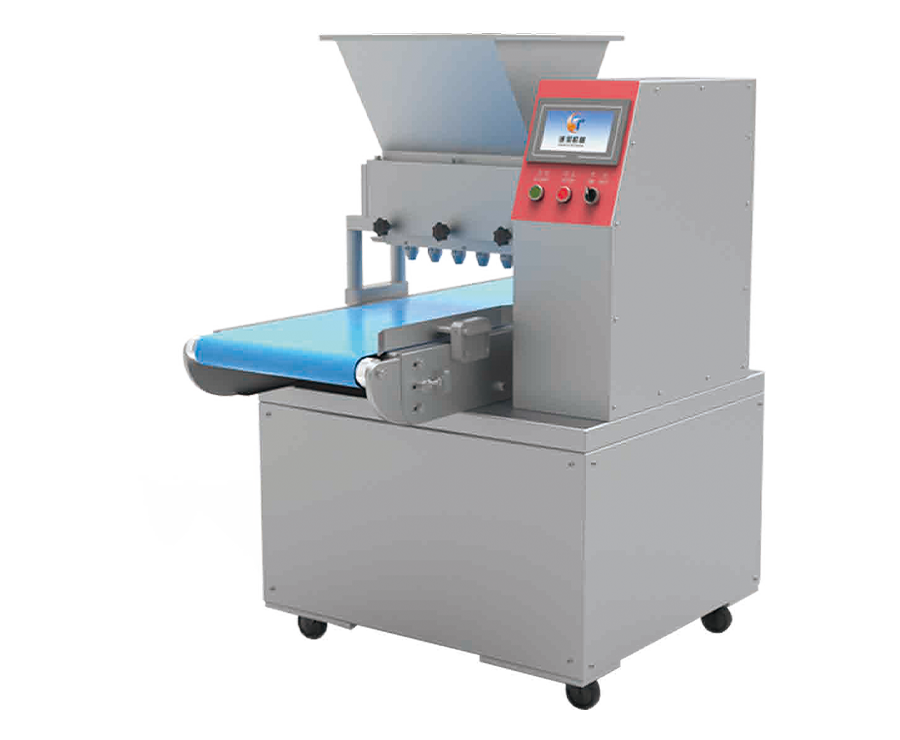 CT-GD400/600 Automatic Cookie Depositing MachineFor soft or sticky doughs, the CT-GD400/600 automatic cookie machine offers adjustable portioning, thickness and cutting, interchangeable molds and 200–300 kg/h capacity.View Product →
Match the Depositing Method to Your Dough
Before comparing quotations, compare doughs. A head that deposits a soft chocolate chip mix beautifully can struggle with a stiff shortbread or a gluten-free blend that behaves like paste. When a customer sends us a recipe and a photo of their dough on the bench, this is roughly the shorthand we use to narrow the field.
| Method | Doughs it suits | What you gain | What to watch |
|---|---|---|---|
| Wire-cut | Soft to medium doughs with chips, nuts, oats or fruit | Clean portion edges and gentle handling of inclusions | Wire tension and dough temperature; warm dough smears instead of cutting |
| Piston depositor | Sticky, high-fat or very soft mixes | Accurate volume on unstable doughs and batters | Suction and tailing at the nozzle; nozzle diameter must match the recipe |
| Rotary moulder | Firm short doughs for biscuit and shortbread bases | Sharp shapes and very even thickness | Dough must release cleanly from the die; less forgiving with inclusions |
| Extrusion with sensor | Simple round products at a steady pace | Straightforward entry point, easy to operate | Sensor drift and cleaning time; less tolerant of frequent recipe changes |
Where the Depositor Sits in Your Line
A depositor never works alone, and most of the problems blamed on the head actually begin upstream. Dough that has been mixed too warm, or rested too briefly, will climb the hopper walls, stick to the rollers and drop uneven portions no matter how carefully you tune the machine. Getting consistent input is half the job, which is why the mixing stage deserves as much attention as the depositing stage.
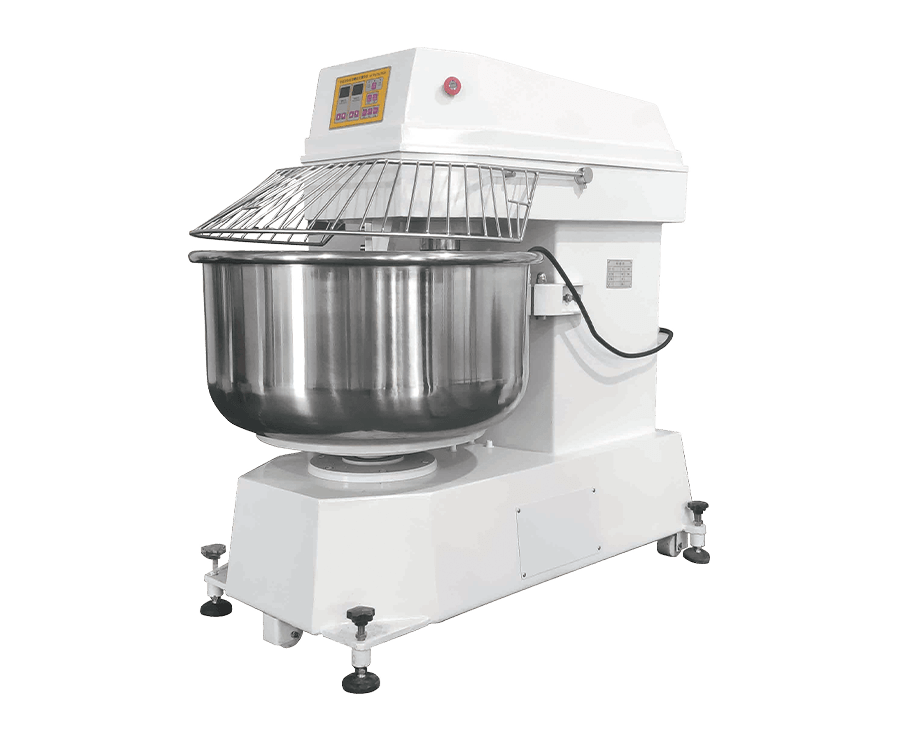 ST-210 Vertical Dough Mixer for Consistent Dough PreparationBecause even depositing starts with consistent dough, the ST-210 vertical mixer offers 48–300 L bowls and food-grade stainless construction for preparation ahead of forming.View Product →
In practice, a workable cookie line reads from left to right: mixing, resting or chilling, depositing, optional coating or filling, baking, cooling and packing. Each handover has its own tolerance. Dough that leaves the mixer at the right final temperature and gets a short rest will deposit far more evenly than dough pushed straight from bowl to hopper. If you are planning more than one product, it is worth seeing how the stages fit together before committing, and our cookie and maamoul production line page shows how depositing, arranging and baking are joined in a single flow.
Settings That Quietly Decide Your Yield
Dough temperature and fat behaviour
Fat is the variable that surprises people most. A dough that deposits perfectly at 18°C can turn greasy and slack at 24°C, and the portions start spreading on the tray before they ever reach the oven. Keep the dough cool, keep the hopper topped up in small batches rather than one large load, and watch the room temperature in summer. Small habits here save more scrap than any control panel adjustment.
Weight checks and drift
Weigh ten pieces at the start of a shift, ten at the middle and ten at the end. If the trend climbs, the dough is usually warming or the hopper is running low. If it swings randomly, look at the feed rollers and the nozzle condition. A deposit weight check takes two minutes and tells you more than an hour of guessing.
Inclusions and nozzle sizing
- Match the nozzle to the largest inclusion, not the average one.
- Reduce the chunk size rather than forcing the machine to push harder.
- Keep sticky dried fruit lightly dusted so it releases from the head.
- Record the settings that worked, so the next run starts where the last one finished.
Throughput, Changeovers and the Cost of Stopping
Buying for today's volume is a comfortable decision and often an expensive one. It is worth asking what your busy season looks like, how many trays you fill on your best week, and whether a second shift is realistic within two years. A machine that runs at the edge of its capacity every day leaves no room for a broken wire, a late dough delivery or an unexpected order.
Changeover speed matters just as much as raw output. If you bake four products, the minutes spent swapping nozzles, adjusting tray spacing and re-checking weights are the real cost per product, and they repeat every week. A short, written changeover sequence, practised once with the operator who will actually run it, usually cuts that time by more than a specification upgrade would.
 ST-520/620/302 Pastry Machine for Danish and BiscuitsWhen changeover speed and range matter, this pastry machine supports Danish, bread, biscuits and pastry with dual rolling, adjustable thickness and interchangeable molds.View Product →
As your range widens, the same forming platform often carries you into pastries, filled pieces and coated products, which is why we prefer to talk about the range you expect in three years rather than the single item you need this month.
Hygiene Questions Worth Asking Before You Buy
Cleaning is where a bargain machine reveals itself. Ask how long a full clean takes, whether the hopper and head come off without tools, and whether the frame allows a brush to reach the corners where dough collects. Then ask to see it done.
- Are food-contact parts removable without tools, and can they be washed separately?
- Are the welds smooth and the frame raised enough to clean underneath?
- Where does dough accumulate during a normal shift, and how is it cleared?
- Are electrical enclosures protected against the washdown your team actually performs?
- Is there a documented cleaning routine, or does it live in one operator's memory?
What Good Support Looks Like After Delivery
The machine arriving is the easy part. What decides the next five years is whether someone answers when a wire snaps on a Saturday, whether spare parts are held in stock, and whether the person commissioning the equipment has actually run a bakery line. Since our own teams handle engineering, manufacture, installation and technical service, we tend to ask a lot of questions before quoting: your dough, your tray sizes, your floor space, your power supply, your staffing. Those answers shape the machine more than any catalogue page.
If you are still at the stage of comparing sketches and recipes rather than suppliers, that is a good place to be, and you are welcome to talk to our team about what your dough is doing now.
A cookie dough depositor will not fix an unstable recipe, and it will not replace the judgement of a baker who knows when a mix feels right. What it does is remove the part of the day that repeats: the same weighing, the same scooping, the same small inconsistencies that show up later as complaints. Get the dough right, match the method to the mix, and check your weights more often than feels necessary. Do that, and the machine quietly becomes the least interesting thing in your bakery, which is exactly what good equipment should be.
Related Products
Copyright © Shanghai Chengtao Machinery Co., Ltd. All rights reserved.  Food Machinery Manufacturers
Contact Us