
 en
 English
 Español
 Français
 русский
 عربى

Conical Dough Rounder: How It Works, Dough Settings, and Where It Fits
Content
- 1 What a Conical Dough Rounder Does
- 2 How the Cone Actually Rounds the Dough
- 3 Does It Stretch the Surface Like Hand Rounding?
- 4 Dough Types, Hydration, and the Settings That Matter
- 5 Where the Rounder Sits in the Line
- 6 Throughput, Care, and Small Habits That Protect Roundness
- 7 Choosing a Rounder That Fits Your Bakery
A conical dough rounder is one of those machines that looks almost too simple to matter. A cone turns, dough pieces ride along its inner surface, and neat balls come out the other side. Spend half an hour next to one on a working bakery line, though, and the details start to show: how the cut faces from the divider close up, how the pieces climb and fall in a slow spiral, how they hold their shape when they land on the tray. Those small behaviours are the whole point of the machine.
This article explains what a conical rounder is doing to your dough, how it compares with rounding by hand, and how to set one up so it behaves the same way at the start of a shift as it does at the end.
What a Conical Dough Rounder Does
After a divider cuts the dough mass into pieces, each piece is a rough chunk with several exposed cut faces, uneven internal stress, and a surface that has not yet decided what shape it wants to be. Move that piece straight into moulding or proofing and you get ragged edges, uneven gas retention, and balls that flatten differently from one another.
A rounder exists to fix three things at once:
- Shape — turning the cut chunk into a symmetrical ball with even dimensions, so downstream settings can be repeated shift after shift.
- Surface — drawing a continuous skin across the piece so the sticky cut faces are tucked inside and the outside is dry enough to handle.
- Structure — arranging the gluten at the surface into a taut, slightly elastic membrane that can hold gas during proofing and spring in the oven.
The conical design is one of several ways to do that. Belt rounders drag the piece along a moving track; umbrella rounders carry it in a circular channel. A cone works differently, and that difference matters most for soft and medium doughs.
How the Cone Actually Rounds the Dough
The working part is a cone-shaped drum on a near-vertical axis, rotating inside a stationary rim or bowl. Dough pieces are fed into the gap between the two surfaces, usually from the divider above, and what happens next is a combination of friction and gravity.
The rotating surface grips the bottom of the piece and carries it around. Because the cone is tapered, the surface speed at the contact point changes as the piece travels, and the piece is pushed slightly up the incline before gravity pulls it back down. In practice it rolls dozens of times in a few seconds, tracing a spiral and turning on more than one axis. That multi-directional rolling is what closes the seam and draws the outer layer of dough into a skin.
Two things control how well it works:
- The gap and slope of the cone. Too tight, and the piece is squeezed and mangled. Too loose, and it slides instead of rolling.
- The dusting flour or light oil film. This is the least glamorous setting on the machine and the one most often wrong. Too little, and the dough smears and sticks. Too much, and the piece loses grip, skates around without rolling, and comes out with an open seam and a floury coat that never quite forms a skin.
Rounding time is short, but it is not the same for every dough. Soft, well-developed dough needs only a few passes, while a stiffer dough needs longer on the cone — and even then the surface may tear rather than stretch.
Does It Stretch the Surface Like Hand Rounding?
This is the question bakers ask most often, and the honest answer is: yes, but not in exactly the same way.
Hand rounding builds surface tension by dragging the piece across the bench in a circular motion, pinning part of it with the palm. The result is a tight skin and a characteristic small pucker on the underside. A conical rounder builds tension by rolling the piece repeatedly, so the skin develops from the outside in and the seam closes gradually in a spiral rather than being pressed shut at one point. On a well-adjusted machine the underside looks smooth, with at most a faint swirl that usually disappears during proofing.
The differences show up more after baking than before. Pieces with a proper skin hold gas better, rise more evenly, and produce a more symmetrical crumb. If the rounder is overloaded, running too fast, or the dough is too stiff, you get the opposite: a torn patch that opens into a rough crust, or a seam that splits during proofing. That is a setting problem, not proof that machine rounding is inferior.
Where hand rounding still wins is small batches and very delicate doughs, where a baker can feel the piece and adjust pressure in a way a fixed gap cannot.
Dough Types, Hydration, and the Settings That Matter
There is no single correct setting for a conical rounder, because the machine only reacts to the dough that arrives. The table below is an indicative starting point; flour strength, dough temperature, and the mixing schedule will shift the numbers in your plant.
| Dough family | Typical hydration | Behaviour on the cone | What to adjust |
|---|---|---|---|
| Soft white bun and milk bread | 58–65% | Rounds quickly and forms a skin easily | Light dusting, moderate cone speed |
| Lean bread dough | 60–62% | Tight, clean balls with reliable seam closure | Standard setting; keep dough temperature in range |
| Stiff doughs (bagel, pretzel) | 50–55% | Rolls slowly; surface can tear instead of stretching | Slightly longer rounding, warmer dough |
| Wholegrain and high-bran dough | 62–68% | Bran particles interrupt the skin as it forms | Shorter rounding, gentler handling downstream |
| Enriched doughs (brioche, milk-rich) | 55–65% | Slippery; tends to slide rather than roll | More dusting flour, check dough temperature |
| Dough pieces for freezing | Varies | Needs a strong skin to survive the freezer | Round gently, move to trays promptly |
Beyond the cone itself, three upstream habits decide whether rounding works: consistent piece weight from the divider, a dough temperature that keeps the surface tacky rather than wet, and a mixing stage that develops gluten enough to hold a skin without turning the dough rubbery.
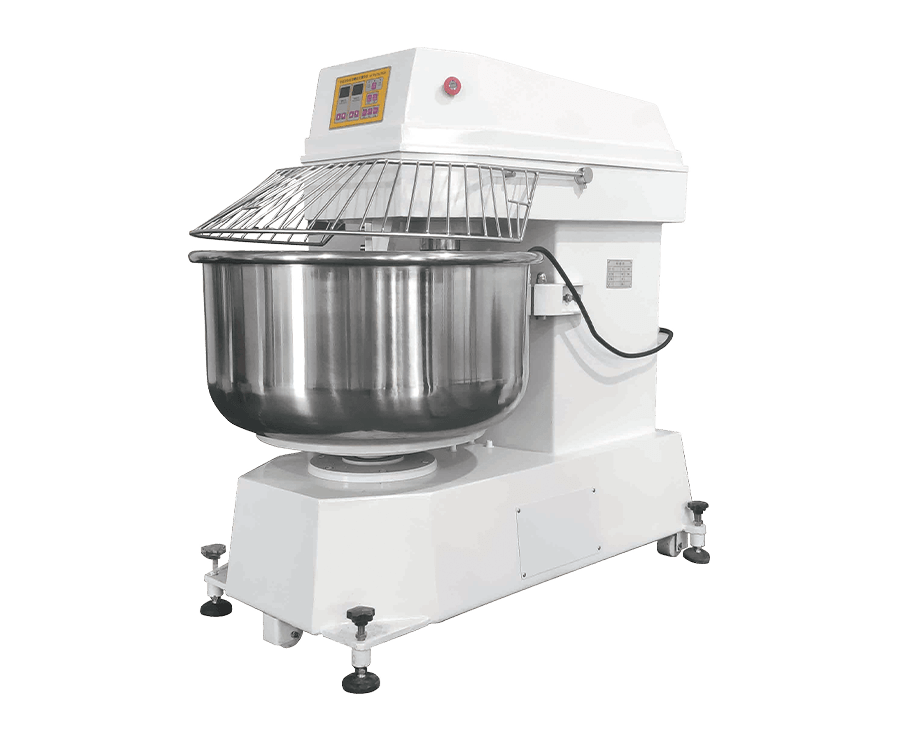 ST-210 Vertical Dough MixerRanges from 48 L to 300 L with multiple power configurations, food-grade stainless steel construction, and preparation-focused design for dough before rounding and forming.View Product →
Where the Rounder Sits in the Line
In a typical bread or bun line the sequence runs: divider, conical rounder, intermediate proofer, then moulder or former. The rounder's output has to match the divider's piece weight and the proofer's capacity; a rounder running faster than the divider simply recirculates dough and damages it.
For frozen product the order changes slightly. After rounding, pieces often go straight to a tray aligner so they can be frozen individually without touching, which is why rounders are sometimes specified together with an aligning table rather than as a standalone unit.
 Ball Rounding Machine with Tray AligningCombines ball rounding and tray aligning at 80–100 pcs/min with stepless speed control, fitting lines that need separate pieces before freezing or forming.View Product →
Downstream, the quality of rounding shows up in how consistently the forming stage can work. A piece with a proper skin slides through an automatic bread forming machine without sticking or tearing; a piece without one drags, and the operator spends the shift adjusting settings that were never the real problem.
Throughput, Care, and Small Habits That Protect Roundness
Most conical rounders are mechanically simple, which is a good thing on a production floor. That simplicity also means the machine is sensitive to anything that changes friction: flour build-up, a scratched cone surface, a worn drive belt, or a room that has warmed up since the morning.
A short daily routine covers most of it:
- Brush down the cone and rim at every changeover; compacted flour changes the surface grip.
- Check the dusting system and the flour itself — a clogged nozzle produces exactly the same symptom as dough that is too soft.
- Inspect the cone surface for scoring or polishing; a shiny, worn patch will not carry dough reliably.
- Record dough temperature at the divider, not only at the mixer. Dough that behaved well at 9 a.m. can behave differently at 3 p.m.
If balls come out with a rough patch or a small tail, the cone is almost always running too fast or the dusting rate is too low. If the dough smears and sticks, look at dough temperature and dusting flour first. If the pieces look perfect but collapse in the proofer, the seam is still open and the rounding stage is too gentle.
Choosing a Rounder That Fits Your Bakery
Before comparing models, write down four numbers: piece weight range, pieces per minute required by the proofer, the softest and stiffest dough you actually run, and the space available between divider and proofer. A rounder that handles your heaviest dough but slows the line on soft buns is the wrong machine, and vice versa.
Then think about how the machine will be fed and what it must hand off to. Some rounders discharge directly onto a proofer conveyor; others need an aligning table to place pieces in trays. That choice affects labour far more than the cone itself does.
It also helps to trace problems backwards. Most rounding complaints — uneven shape, open seams, torn surfaces — begin in mixing and dividing rather than on the cone, as this discussion of how dough preparation determines forming performance explains.
A conical dough rounder will not rescue a dough that was mixed inconsistently, divided unevenly, or left too warm on the bench. What it will do, when the cone, the gap, and the dusting flour are set properly, is turn an unpredictable stream of dough chunks into a predictable stream of balls with a skin strong enough to survive proofing, moulding, and the freezer. That predictability is what makes the rest of the line easier to run.
Related Products
Copyright © Shanghai Chengtao Machinery Co., Ltd. All rights reserved.  Food Machinery Manufacturers
Contact Us