
 en
en English
 Español
 Français
 русский
 عربى
عربى
Stability Isn't Magic: Understanding Repeatability vs. Machining Precision
Content
- 1 Two Things That Look the Same Until They Don't
- 2 What Machining Precision Actually Means in Food Equipment
- 3 What Repeatability Means—and Why It's Harder to Guarantee
- 4 The Engineering Decisions That Create (or Destroy) Repeatability
- 5 The Variables That Shift Your Output Without Touching the Machine
- 6 How to Verify Repeatability Before You Commit to a Machine
Two food factories, same encrusting machine model, same mooncake recipe. One runs 10-hour shifts with filling weight deviations under 2 grams across 20,000 pieces. The other sees 6–8 gram swings by mid-shift, rising reject rates after hour four, and quality complaints from a retail buyer who expected uniformity. The machines are identical on paper. The results are not.
This gap isn't explained by operator error or recipe inconsistency alone. It comes down to a distinction that most equipment conversations never surface clearly: the difference between a machine that is precise and a machine that is repeatable. These are not the same property, they don't fail in the same way, and they don't get fixed by the same intervention.
Two Things That Look the Same Until They Don't
When a food factory evaluates a new forming or encrusting machine, the conversation usually centers on output rate and fill accuracy. The machine fills to ±1.5 grams. It produces 3,600 pieces per hour. The skin-to-filling ratio holds within specification. These are precision claims—and they're typically demonstrated during a factory trial run of 30 to 60 minutes under controlled conditions.
What the trial doesn't show is what happens at hour six when the dough temperature has risen two degrees. Or on the second shift when a different operator sets the pressure parameters slightly differently. Or in week three, after the filling feed tube has accumulated residue that subtly narrows the flow path. Precision describes the machine's performance at a moment in time. Repeatability describes whether that performance holds across time, conditions, and operators.
A machine can be precise without being repeatable. It can hit ±1.5 grams in a controlled trial and drift to ±5 grams under production conditions. Conversely, a machine can be highly repeatable without perfect precision—consistently producing pieces at a fixed deviation from target, which is at least predictable and correctable. For a food factory running high-volume lines, repeatability is almost always more operationally valuable than one-time precision—because repeatability is what determines whether your quality standard survives a full production week.
What Machining Precision Actually Means in Food Equipment
Precision, in the engineering sense, refers to how closely a machine can hit a specified target value in a single measurement. In food machinery, this translates to concrete output parameters: filling weight per piece, dough skin thickness, piece weight, seal width, or shape geometry.
A forming machine rated for ±1 gram filling accuracy is making a precision claim. Under controlled conditions—consistent dough hydration, stable room temperature, a warmed-up machine, an experienced operator—it should produce pieces within that tolerance. Precision is essentially a static property: it describes the machine's mechanical resolution, the quality of its feed systems, and the tolerance of its molds and cutting mechanisms.
Precision matters for compliance. If your retail buyer specifies a piece weight of 30 grams ±2 grams, your machine must be capable of hitting that window. But precision is the entry-level requirement. It tells you the machine can, under ideal conditions, produce to specification. It says nothing about whether it will—consistently, across shifts, across batches, across seasons. That question belongs to repeatability. The process of translating artisan know-how into repeatable production parameters is precisely this challenge: taking what a skilled hand can do once and engineering a machine to do it the same way, ten thousand times in a row.
What Repeatability Means—and Why It's Harder to Guarantee
Repeatability is the ability of a process to produce the same result under the same conditions across multiple trials over time. The key phrase is "over time." A machine that hits its precision target once has demonstrated accuracy. A machine that hits it consistently across an eight-hour shift, across different operators, and across weeks of production has demonstrated repeatability.
The international measurement standard ISO 5725-2, which defines methods for determining repeatability and reproducibility, formalizes this distinction by separating two types of variation: variation within a set of measurements made under identical conditions (repeatability), and variation across conditions that change—different operators, different batches, different days (reproducibility). In food production, both matter. A machine that's repeatable within a shift but not reproducible across shifts creates quality inconsistency that's nearly impossible to trace and correct.
Repeatability is harder to guarantee than precision because it depends on factors that go beyond the machine itself. Mechanical wear changes tolerances over thousands of cycles. Temperature fluctuations alter dough behavior. Ingredient variability shifts filling viscosity. Operator technique introduces micro-variations in setup. A machine that is genuinely repeatable must be designed to hold its output stable in the face of all these inputs—not just under clean conditions at the point of sale.
The Engineering Decisions That Create (or Destroy) Repeatability
Repeatability isn't an accident. It's the result of specific engineering decisions made during machine design—decisions that are visible in the machine's specifications if you know what to look for.
Synchronous dual-feed systems are one of the clearest repeatability indicators in food forming equipment. When dough and filling are fed by independent, electronically synchronized motors rather than mechanically linked drives, the ratio between skin and filling can be precisely controlled and held constant even as material properties change. A single-drive system that links both feeds mechanically will drift when material viscosity changes, because the system has no mechanism to compensate independently for each input.
Temperature control in the filling feed path directly affects repeatability for products with fat-based or temperature-sensitive fillings. A filling that changes viscosity by 15% between 18°C and 22°C will feed at different rates at those two temperatures, producing different piece weights—even if the machine's mechanical settings haven't changed. Equipment with enclosed, temperature-regulated filling chambers maintains material consistency as ambient conditions shift through a production day.
Variable frequency drive (VFD) motors allow output speed to be tuned independently of the mechanical system's base frequency. This means small adjustments to compensate for material variation can be made without stopping the line—preserving repeatability without interrupting production. Fixed-speed drives force a binary choice: run at set speed or stop.
Mold material and locking mechanism tolerance determines how consistently the forming geometry is reproduced across thousands of cycles. Molds machined to tighter tolerances and locked with positive-stop mechanisms hold their geometry longer under thermal and mechanical cycling than those held by friction or manual adjustment. Understanding key specs, hygiene standards, and line setup for food forming machines includes evaluating these mechanical details—not just rated output.
The Variables That Shift Your Output Without Touching the Machine
Even a well-engineered machine produces inconsistent output when the inputs it's working with are inconsistent. This is the category of variation that catches factories off guard, because the machine hasn't changed—and yet the output has.
Dough hydration is the most common culprit in forming lines. A 2% change in water content changes dough extensibility and elasticity, which in turn affects how the skin stretches during forming and how consistently it seals. A machine set up for 48% hydration dough will produce different results with 50% hydration dough—not because it's malfunctioning, but because the material it's forming has changed. Locking in dough mixing parameters and monitoring mixer output before it reaches the forming stage is a process control measure, not a machine specification, but it directly determines whether the forming machine's repeatability holds.
Filling temperature follows the same logic. How encrusting machines maintain consistency with temperature-sensitive ingredients comes down to controlling the filling's physical state, not just the machine's feed rate. A lotus paste filling that arrives at the machine at 16°C on a winter morning and 24°C on a summer afternoon will behave differently in the filling chamber regardless of what the machine's settings say.
The relationship between material properties and machine parameters is a two-way design problem. Linking pastry filling properties to the right machine settings means the recipe and the equipment configuration are developed together, not independently. Factories that treat these as separate domains—"the recipe team handles the filling, the production team handles the machine"—consistently see repeatability problems that neither team can fully explain or fix alone.
How to Verify Repeatability Before You Commit to a Machine
A 30-minute factory trial is enough to evaluate precision. It is not enough to evaluate repeatability. If the purchasing decision is significant, the verification process should be designed to stress-test the machine's stability over time and across conditions—not just confirm it works on a good day.
A practical repeatability verification for food forming equipment works as follows. Run a continuous production trial of at least 200 pieces without interruption, sampling every 20th piece for weight measurement. Calculate the mean and standard deviation of the sample. Then change one controlled variable—ask the operator to adjust the filling pressure by 5%, or introduce a dough batch prepared at slightly different hydration—and run another 100 pieces under the adjusted condition. Compare the distributions. A machine with genuine repeatability will show a predictable, manageable shift in response to the changed variable, not a chaotic spread.
Run the same trial across two different operators without telling either one what settings the other used. If the output distributions differ significantly between operators, the machine's repeatability depends on operator calibration—which means it will vary across shifts in production. That's not a machine problem you can train away; it's a design problem that requires parameter locking at the machine level.
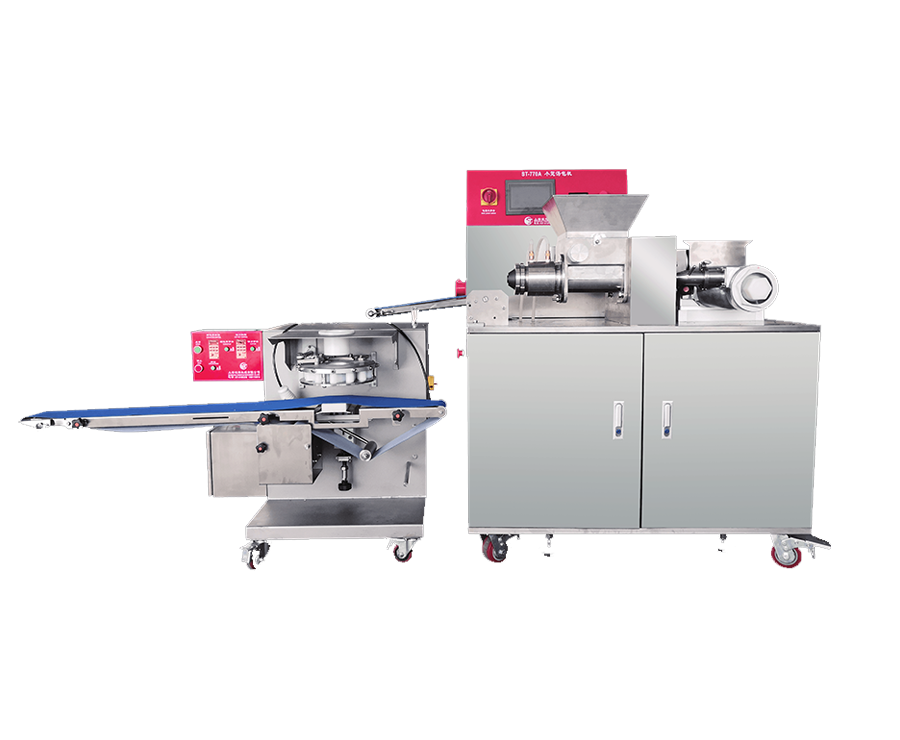
Check the machine's parameter logging or display interface. A machine that allows operators to view and lock filling weight, skin ratio, and speed parameters digitally is more likely to be repeatable across shifts than one that relies on analog dials and operator memory. The ST-168 series automatic encrusting machine specifications illustrate what microcomputer-controlled parameter management looks like in practice: settings that can be stored, recalled, and locked reduce the operator-to-operator variation that undermines repeatability in multi-shift operations.
Repeatability isn't a feature you accept on faith from a spec sheet. It's a property you verify through structured testing—and a property you protect through recipe discipline, material control, and parameter management once the machine is in production. The factories that achieve true output stability aren't the ones with the most precise equipment. They're the ones that understand what stability requires and build their processes around it.
Related Products
Copyright © Shanghai Chengtao Machinery Co., Ltd. All rights reserved.  Food Machinery Manufacturers
Contact Us